Trees
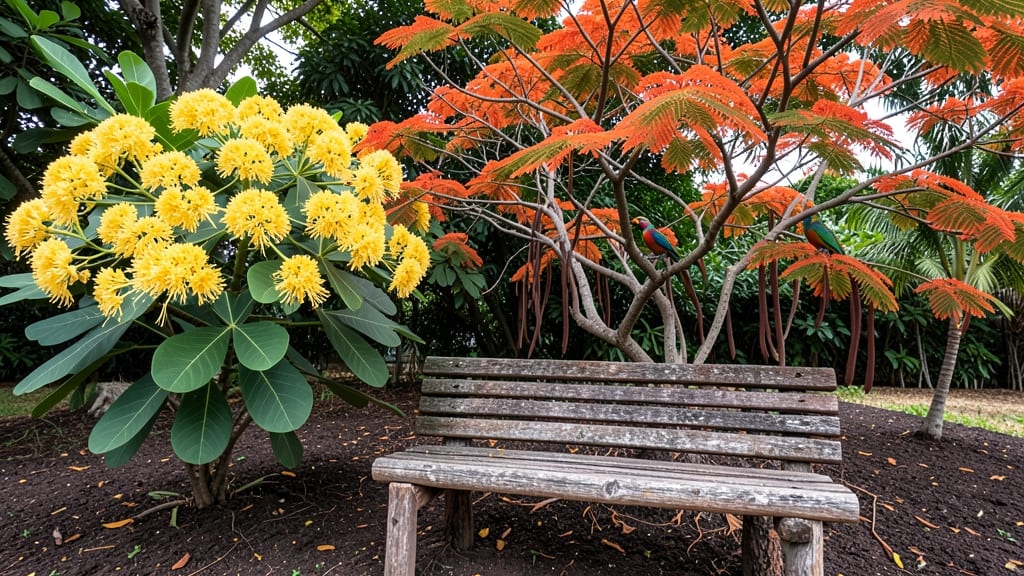
Tropical ornamental trees bring bold colors and dense foliage to gardens with almost no effort, flourishing in warm regions where they demand minimal trimming, hydration, or pest management. Standout varieties like hibiscus, bougainvillea, and frangipani produce continuous blooms when given proper sunlight and soil conditions.
These eye-catching plants thrive in USDA zones 9-11, where temperatures stay above 40°F year-round. 🌺 Most varieties adapt well to sandy or loamy soils as long as drainage prevents root rot—a common issue in heavy clay.
Unlike temperate trees, they often bloom continuously rather than seasonally, making them perfect for creating vibrant landscapes with minimal seasonal color shifts. My top tip? Plant them near patios or walkways where their fragrant flowers can be enjoyed up close.
For best results, I recommend grouping them by water needs—some like bougainvillea tolerate drought once established, while hibiscus prefers consistent moisture. Adding a balanced 10-10-10 fertilizer twice yearly keeps blooms abundant without overfeeding. Pruning just after flowering encourages fuller growth, and most varieties resist pests naturally when healthy.
💡 In This Article
- Climate and Soil Requirements for Thriving Tropical Trees
- Low-Maintenance Care Tips for Long-Lasting Blooms
Climate and soil requirements for thriving tropical trees
Tropical ornamental trees flourish in USDA hardiness zones 9-11, where average winter temperatures stay above 40°F and summers remain consistently warm. The key factor is their inability to tolerate frost—even brief dips below 32°F can damage leaves and flowers permanently.
Coastal regions provide ideal conditions with their natural humidity, while inland areas require additional moisture retention strategies like mulching. These trees thrive in 6-8 hours of direct sunlight daily, though some like frangipani tolerate partial shade in hotter climates.
The soil requirements vary slightly by species but generally favor well-draining, slightly acidic to neutral pH (6.0-7.0). Bougainvillea, for example, thrives in sandy or gravelly soils that mimic its native rocky habitats, while hibiscus prefers richer, loamy soils with organic matter.
Coastal varieties often develop deeper root systems to access salt-tolerant moisture, making them perfect for seaside gardens. The critical detail is drainage—waterlogged roots lead to root rot within 24-48 hours in most tropical species.
Humidity plays a surprising role in their growth patterns. In dry climates, these trees develop thicker cuticles and smaller leaves to conserve moisture, while high humidity encourages lush foliage and continuous blooming. Frangipani, for instance, produces its signature fragrant flowers more prolifically when atmospheric humidity stays above 50%.
This is why coastal plantings often outperform inland ones—salty sea breezes naturally boost humidity levels while providing gentle pruning through wind exposure.
Soil amendments can make a dramatic difference in performance. Adding 1-2 inches of compost annually improves nutrient retention without compacting the soil, while perlite or coarse sand helps sandy soils retain moisture.
For container-grown specimens, a mix of 60% potting soil, 20% perlite, and 20% coconut coir mimics ideal tropical conditions. The science behind this is simple: tropical trees evolved in nutrient-poor volcanic soils, so they've adapted to thrive with minimal fertilization when given proper drainage.
One often-overlooked adaptation is their response to wind patterns. Coastal varieties like the sea grape tree develop flexible stems that bend rather than break in storms, while inland species grow taller with sturdier trunks. This structural difference explains why coastal plantings often require less staking than their inland counterparts.
The trade-off? Coastal trees may need occasional rinsing to remove salt buildup from sea spray, which can accumulate on leaves and stems over time.
For gardeners in marginal zones (8b-9a), microclimates become crucial. Planting near south-facing walls or using protective covers during cold snaps can extend the growing season by 2-4 weeks.
The key is understanding each species' specific cold tolerance—hibiscus typically handles 28°F for short periods, while bougainvillea may survive 25°F but with leaf damage. This precision in placement turns what might seem like challenging conditions into perfect growing opportunities.