Pruning
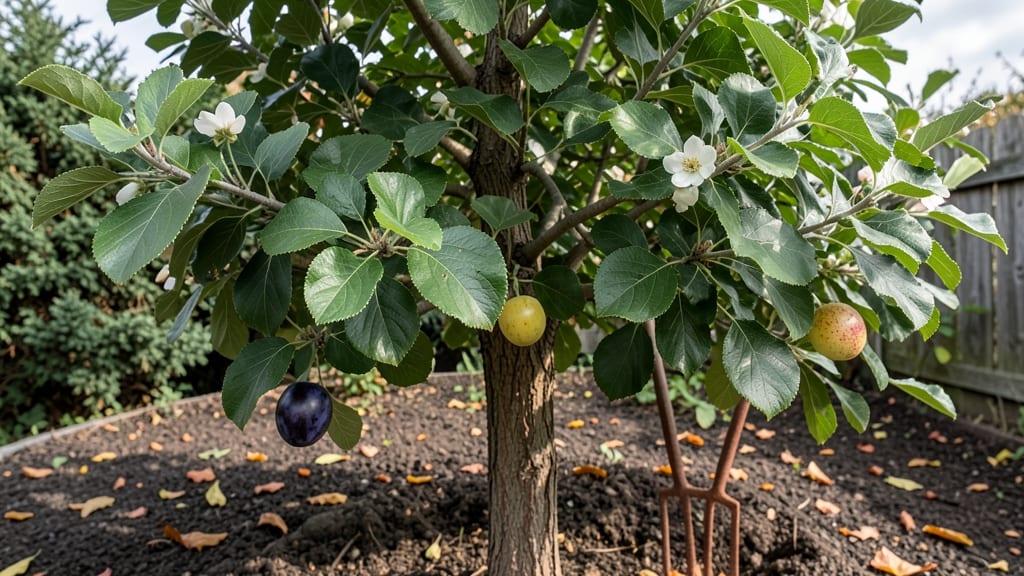
Plum trees stand out because their leaves are more elongated than cherry leaves and their bark develops distinctive fissures as they age. 🌳 The fruit's stone pit is another key detail—plums have a smoother, more rounded pit compared to the heart-shaped pits of peaches.
I always recommend examining the branch structure too, as plum trees typically grow with alternating branches, a trait that sets them apart from many other fruit-bearing trees.
For accurate identification, consider the season: spring brings fresh green leaves and buds, while winter reveals the cracked bark pattern. Comparing these traits with reference photos of known varieties can help narrow down whether you're dealing with a European plum (often purple) or a Japanese plum (often yellow or red).
💡 In This Article
- Distinguishing Plum Tree Leaves and Bark Features
- Plum Tree Fruit and Branch Patterns for Accurate ID
Distinguishing plum tree leaves and bark features
Plum tree leaves are typically 2-4 inches long with a smooth, oval shape and fine, saw-like serrations along the edges.
Under magnification, these serrations appear as tiny, evenly spaced teeth that create a delicate, almost lacy appearance when sunlight filters through. 🌿 The leaf surface is usually glossy on top and slightly dull underneath, a trait that helps distinguish them from apricot leaves, which tend to be more matte and fuzzy.
The veins are prominent but not as bold as those on cherry leaves, which often have a more pronounced central vein.
The bark of a mature plum tree develops into one of its most distinctive features—a network of deep, irregular fissures that resemble an alligator's hide.
Young trees have smoother, reddish-brown bark that gradually darkens and cracks as the tree ages, creating a textured pattern that's less uniform than the smooth, gray bark of apple trees. In winter, these cracks become more pronounced, revealing lighter-colored inner bark that contrasts sharply with the outer layer.
This seasonal change is a key identifier, especially when comparing to cherry trees, whose bark tends to remain smoother and less fissured.
Springtime offers another critical clue: plum trees produce small, rounded buds that appear before the leaves emerge, often in clusters of 2-3 along the branches.
These buds are typically 1/4 to 1/2 inch long and have a slightly sticky, resinous coating when touched. 🌱 This early budding—combined with the tree's tendency to bloom before leafing out—helps differentiate it from apricot trees, which usually have larger, more elongated buds that appear later in the season.
The timing of these buds can also indicate the specific variety, as Japanese plums often bloom earlier than European varieties.
One common point of confusion is distinguishing plum leaves from cherry leaves, especially when both trees are young. Plum leaves are generally 10-20% longer than cherry leaves and have a more tapered tip, resembling an elongated ellipse rather than the broader, more rounded shape of cherry leaves.
Additionally, plum leaves often have a slight downward curve at the tip, while cherry leaves tend to be more symmetrical. This subtle difference becomes more noticeable when examining multiple leaves along a branch, where the consistent shape of plum leaves creates a uniform pattern.
For a hands-on approach, try the "leaf rub test": gently rub a mature plum leaf between your fingers. The serrated edges create a distinct, slightly abrasive texture that's absent in smoother-leaved trees like peaches.
This tactile difference, combined with the bark's fissured pattern, provides a reliable way to confirm identification even when fruits aren't present. 🔍 The combination of these physical traits—leaf shape, bark texture, and seasonal changes—makes plum trees uniquely identifiable among their fruit-bearing counterparts.