Watering
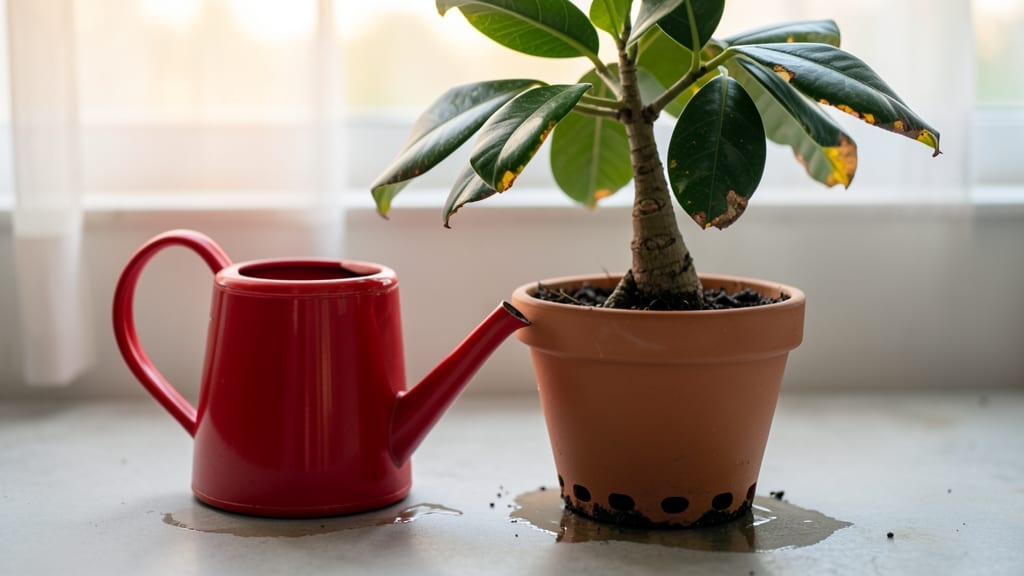
Overwatered trees exhibit yellowing leaves, root rot, and slow growth from oxygen starvation in soggy soil. Correct it by enhancing drainage, trimming damaged foliage, and spacing out waterings to allow soil to dry between sessions while checking for mold or fungal issues.
When roots sit in waterlogged soil, they suffocate and can't absorb nutrients properly—think of it like drowning at the cellular level. 🌱 The first signs often appear as leaves turning yellow or brown, especially on lower branches, while the bark may develop dark spots or ooze.
I’ve seen this happen most dramatically with heavy clay soils or after prolonged rainy seasons, where even well-meaning gardeners overcompensate with extra water. The key is to act fast before the damage spreads to the entire root system.
For recovery, start by testing soil moisture with your finger—if it stays damp more than an inch down after 24 hours, you’re overdoing it.
Amending the soil with organic matter like compost or perlite helps break up compacted areas, while pruning only the most affected branches prevents further stress on the tree.
Adjusting your watering schedule to match your local climate (like deep waterings once a week in summer vs. monthly in winter) makes all the difference.
💡 In This Article
- Recognizing Overwatered Tree Symptoms and Root Damage
- Tree Recovery Plan: Watering Adjustments and Soil Care
Recognizing overwatered tree symptoms and root damage
When trees receive too much water, their roots suffocate because excess moisture displaces oxygen in the soil, creating anaerobic conditions. This oxygen deprivation triggers a cascade of physiological responses: roots can't absorb water or nutrients efficiently, leading to cellular stress and eventual death of fine root hairs.
The tree's defense mechanism kicks in by shedding leaves—starting with the oldest ones—to conserve energy, which is why you often see yellowing or browning on lower branches first. 🌿 This process mimics how humans might develop edema (swelling) from poor circulation, but in trees, it manifests as wilting despite damp soil.
The most critical symptom to watch for is leaf discoloration patterns: uniform yellowing across entire leaves (chlorosis) signals nutrient deficiencies from poor uptake, while brown, crispy edges suggest fungal infections like phytophthora.
Bark conditions also reveal clues—dark, sunken spots or oozing sap indicate advanced root rot, where pathogenic fungi thrive in waterlogged environments. Compare this to underwatered trees, which show brown, dry leaf edges and soil pulling away from roots when dry, rather than staying perpetually soggy.
Root damage progresses in stages: initially, roots turn black and mushy as they rot, losing their fibrous structure. In severe cases, you might smell a foul, sour odor from the soil—this is hydrogen sulfide gas produced by anaerobic bacteria breaking down organic matter.
The contrast with healthy roots (white or tan, firm to the touch) is stark. What most people don't realize is that even if the top of the tree looks green, the root system could be 80% compromised, making recovery difficult if not addressed immediately. 🌱
Soil texture plays a huge role in how quickly damage appears. Trees in clay-heavy soils (which hold water like a sponge) show symptoms faster than those in sandy loam, where excess water drains more readily.
For example, a maple tree in clay soil might develop root rot within weeks of overwatering, while an oak in well-draining soil could take months to show signs.
This is why amending compacted soil with organic matter—like compost or coconut coir—isn't just about improving drainage; it's about recreating an oxygen-rich environment where roots can breathe.
Fungal infections add another layer of complexity. Pathogens like Phytophthora or Armillaria (the "honey fungus") exploit waterlogged conditions to spread through root tissues, creating a vicious cycle. These fungi produce toxins that further inhibit nutrient absorption, making the tree's decline accelerate.
The key difference from underwatering is that fungal-infected trees often have mushrooms growing at the base or a spongy, hollow feel when you gently probe the soil with a trowel. In contrast, underwatered trees will have dry, cracked soil that resists moisture penetration. 💫
Don't overlook the role of seasonal factors—trees overwatered in winter are at higher risk because cold soil slows microbial activity, masking early rot signs until spring thaw. Meanwhile, summer overwatering can scorch roots due to the heat amplifying anaerobic conditions.
Always check the soil's moisture level by digging down 4-6 inches with a trowel; if it feels damp, hold off on watering. This simple test can prevent irreversible damage in just minutes.